Cost of Wise Inn Fiasco Soares to $12 Million
Update: the Inn is open and looks very nice.
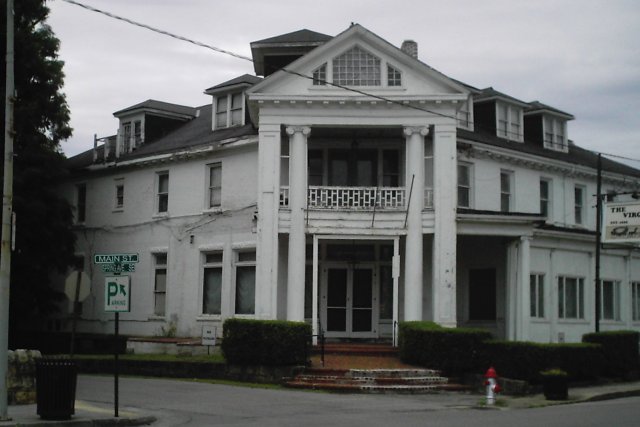
The derelict and empty Wise Inn has stood rotting for decades on main street in Wise Virginia. Wise County and the Town of Wise stands in the middle of the most impoverished region in Virginia. Every year the spectacle of Remote Area Medical serving the needs of several thousand local citizens desperate for basic services such as dental care and jobs makes national headlines. In 2013 that number was 3000 mostly seeking dental care.
Local and state agencies waste millions in questionable deals often done in back rooms in the name of economic development. Everything from phony energy research (between $10-$20 million), a new $30 million convocation center for a local college, etc. have produced nothing and all of these projects has had no measurable benefit to anyone except a small political elite and consultants, contractors, and their friends.
The Wise Inn is the latest fiasco to beset Wise. They claimed the project to renovate the structure would cost only $8 million in government grants to fix up even if it has no business plan and nobody wants to use it. That was about 6 years ago and today the cost has ballooned to as much as $12 million as of December 2012.
Wise County IDA Executive Director Carl Snodgrass says, "It became increasingly obvious that if the project was to succeed, the (IDA) must deal with the reality of accepting a design that would create a viable and sustainable project."
Really Mr. Snodgrass? And how much private sector funding went into this? When did you hold any public hearings on this project or discussed anything in public at all? So they plan to spend the money anyway (if they haven't already) even though the project isn't "viable and sustainable" and has no business plan?
To quote the press,
Officials hope the inn can become a hub for day trips to other attractions around the region, including the Ralph Stanley Museum, the Carter Fold, the Jefferson National Forest's High Knob area, the Southwest Virginia Museum, the Trail of the Lonesome Pine State Outdoor Drama and the Wilderness Road and Natural Tunnel state parks.
The only problem is most of these places have been there for decades and have produced nothing in the way of real jobs or opportunity for the working poor. They simply serve as an excuse to get government grants to enrich a few people.
They gave the Carter Family about $2 million to fix the family barn as a tourist attraction that has produced nothing I know of in the way of jobs or development. (It's a few miles from my house.) The Ralph Stanley House-Museum has already failed and defaulted on its loans. The Wise Inn no doubt won't be far behind if ever finished. Ref. BHC 12/19/2012
- Wholesale Plant Nursery Receives $8 Million for Energy Research
- No It's Not 250 New Jobs in Grayson County Virginia
- 2008 Remote Area Medical in Wise in Pictures
- Remote Area Medical Wise 2011 Ignores Government Waste
- Remote Area Medical Exposes Government Hypocrisy Again in 2014
- Crony Capitalism Comes to Wise County
- Pinnacle Wood Products Follies in Wise County
- Obscene Electrolux Incentive Deal Puts Tennessee at Risk
- Tobacco Commission Sykes Fiasco
- Cost of Wise Inn Fiasco Soares to $12 Million
- Appalachia Resents Label of Third World
- Washington County Supervisor Blasts Obscene Pay Raises
- Exposing the Virginia Tobacco Commission Part 1
- Exposing the Virginia Tobacco Commission Part 2
Additional Information
The Wise Inn in Wise, Virginia has stood empty since I was a child. It has no economic value it seems, it's just another empty building. But to the Virginia Coalfield Economic Development Authority (VCEDA) it's industrial development. They awarded $1.2 million to the Wise County Industrial Development Authority for the restoration and redevelopment of the "historic Inn" project.
The funds are "subject to final approval after the business plan for the inn project is completed. A preliminary assessment of the ambitious project - a joint venture of the Wise County IDA and the town of Wise." The "projected cost estimates approaching $8 million to complete all the recommended improvements. The preliminary plan includes new accommodations atop a parking garage along Lake Street and creation of a courtyard in conjunction with restoration of the original structure."
Note that Wise is in the LENOWISCO service area. How can this be justified for $8 million tax dollars? What jobs will it create? I first called it pork-barrel waste, then I asked some VCEDA officials and got the following that was left out of the newspaper reports:
Before you make those statements, understand that grant approval is conditioned on the entire funding package coming together - $6 Million in PRIVATE dollars, and the balance of about $2 M or so in public funds. There is a rather involved feasibility study that might explain it...Not one penny of the grant you mentioned will be disbursed until all the pieces come together - and it may or may not happen. Again, it attempts to build on the explosive growth at UVA-Wise, the Crooked Road, and the total lack of "quality" lodging in our region. It's a small scale Martha Washington Inn, and it has to be self-sustainable.
This sounds reasonable to me with the private sector having to shell out most of the cost, let's wait and see. It is a nice old building and the Martha Washington Inn in Abingdon is a very nice example. See The Martha Washington Inn, Abingdon VA
The "VCEDA board approved a loan for up to $1 million for a new metals manufacturing and processing business to be located in the Bluefield Industrial Park in Tazewell County. The business is expected to create more than 150 new jobs." But according to officials at VCEDA, we will never know of those jobs are ever created. I sent a letter to the Tobacco Commission, LENOWISCO, and VCEDA on this issue of verification of their job claims. Here is the VCEDA response that was identical to the other two in April 2005:
Thank you for your inquiry regarding job creation by the Virginia Coalfield Economic Development Authority (VCEDA)...I have included the job creation and expansion numbers announced by VCEDA since its creation in 1988. Not all of these projects are still located in the region, but this will give you an idea of what has located here and the projected employment associated with the projects.
We do not track job descriptions and pay scales, but VCEDA statute dictates that we can only assist companies that meet certain criteria for job creation, with one of those criteria being that the company must pay at least 1.5 times the current minimum wage.
That's $10 an hour in 2014. Remember the term "projected" while local press reports stress "created" in years past. (I blame the local press for not clarifying the issue.) Perhaps it would be fair to note in this case VCEDA is at the mercy of the national job market, which seems bent on destroying its blue collar workforce. So what will this company in Bluefield produce for jobs? That too is at the mercy of the national labor market and the risk is well worth the $1 million loan.
Ref. 05/23/2008 Kingsport Times-News
- Bristol Virginia Region 2017
- Tri-Cities Labor Market Report 2011 & 2016
- ARC Virginia Grants Pork and Salaries 2015-16
- 30 Years of Failure in Southwest Virginia
- Disability Still Big Business 2017 in Southwest Virginia
- Bristol Virginia Loses More Retail
- Bristol Trainstation 2017 Still Producing Nothing
- Appalachian Regional Commission a Waste
- Address Corporate Culture Before Handing Out Money
- Suppressing Academic Freedom for Justice
- How Government Exported Black Crime into Ferguson Missouri
- St. Louis Black Youth Gunshot Death Rate
- Crime Rates by Race in Missouri
- California Premier Welfare State
- Diversity, Welfare, Undercurrent in London Race Riots 2011
- Whites Virtually Banned at Harvard
- Jews in Elite Colleges Wrongly Counted as White
- Liberal Racial Hypocrisy in Boston
- Clear Definitions of Words as Used on this Website
- Poor Virginia Children Robbed Again by Illegal Aliens
- Bernie Sanders Wants an American Venezuela
- Welfare for the Rich and Connected, Deficits for Everybody
- Political Correctness Attacks Science
- Diversity-Multicultural Racism
- Virginia's Illegal Alien Underground Labor Force
- Red States Higher Standard of Living
- Why All Illegal Aliens Must Be Deported
- Florida Schools Struggle with Failing Minority Students
- Intelligence, Crime, and Tampa Florida
- New York City Sanctions Immigration Fraud, Crime
- Far-left lunacy:
- How Marxism became racism
- Progressivism as Democratic Totalitarianism
- American capitalism gone with a whimper
- What is the Pseudo-religion of Marxism?
- Why the term Islamic or Liberal fascism?
- Scoping Out Pepe Why We Should Get It Right But Won't
- Illegal Alien Driver pleads guilty to wrong-way wreck, illegal employers to blame
- Illegal alien nailed for child rape in Washington County Virginia
- Culture or I.Q.?
- Race, IQ, and facts liberals ignore
- Race dialogue: same old stuff: It's Culture, Not Racism
- Do 'minorities' really have it that bad?
- Black Liberation Theology and The Audacity of Rhetoric
- It isn't white racism:
- IQ Will Put You In Your Place
- Black/Hispanic failure in public schools is not racial bias
- The Question of IQ versus Race, and the leftist' agenda
- Morality Gap Mirrors Asian/white versus black/Hispanic IQ Gap
- Black college graduation rates under 50 percent
- The real problem in American public schools is liberal racism
- ACLU sues Palm Beach over black graduation rates